Today’s model is another, slightly more complex moon rover from set 926 “Moon Radar Station” from 1978:

Today’s model is another, slightly more complex moon rover from set 926 “Moon Radar Station” from 1978:
Today’s creation is a mini steamroller from a MOC (make your own creation) competition to create a vehicle using 15 pieces or less. Design is created by Alex Sonny:

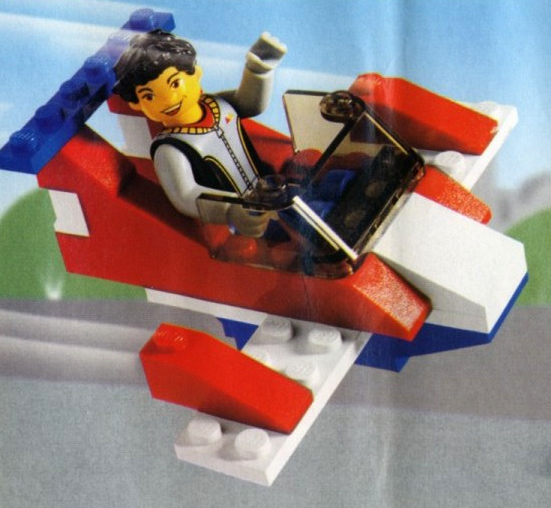
This is a pretty basic airplane from Basic Building Set 515 (1990):

Today we attempted to build a 2011 Lego Kingdoms set, Blacksmith Attack (6918):
 This set is 104 pieces (including all the minifigs and tools). This set mostly uses types of pieces that are fairly common in current/newer sets, but it does require a few technic pieces for the moving parts.
Today’s build is 6350 Pizza To Go (1994)/10036 Pizza To Go (2002).
From set 493 “Space Command Center” (1978) and it’s international equivalent, “Command Centre”, we have a small moon-rover:


Today’s tip is how to print instructions in a booklet to save paper.
Lego’s customer service website provides most of their instruction booklets as a PDF of scans of the instruction booklet. Sometimes they don’t even crop out the hand holding the booklet on the scanner ;-). If you print them as-is, that takes a LOT of paper.
I am using Adobe acrobat reader XI on Windows 7. If you have a different OS or version, it’s possible the instructions might be completely different. Continue reading Booklet Printing
Today’s model is a plane from set 4023 “Fun and Adventure“, released in 2003.  Continue reading 2003 Fun and Adventure Plane
Today’s build is a very simple sports car from a 1971 Kraft promotional set “Mini-Wheel Model Maker No. 3“. 12 pieces (16 if you count the tires individually).
I started out thinking “gee these ascii art arrows look a little tired” and I didn’t want to do symbol font again like I had in another study. So I drew arrows on paper and scanned them in and colored them in photoshop in contrasting colors to visually differentiate.
 Causation (Therefore, For this Reason)
 Substantiation (For, Because)
 Comparison (Like, As)
I was having a more difficult time with Contrast, because I don’t like the ambiguity that it could be confused for a copyright symbol. So I tried several variants. I’ve also tried an X in a box but I didn’t try that one here.
 “official” learned symbol for contrast
 idea 2, “negated” comparison as they are unlike. Supposed to be similar to a not equals symbol.
 idea 3, represent opposing ideas with a yin-yang (but might be offensive or inappropriate to some because of spiritual connotations to other religions?)
 idea 4, contrast symbol with arrows out the sides. Clear enough, doesn’t look like a copyright. Will do for now.
And then I came up with some labels for different inductive question types:
 Observation
 Interpretation
 Application
Coming up with these symbols and then labeling the questions I already had written was quite useful actually. Launched me into a whole study of learning more about inductive study and I learned some useful things that I will blog about later that was improving my study. Plus I could see where I wasn’t asking enough observations, etc.